|
~CAIRO~
|
|
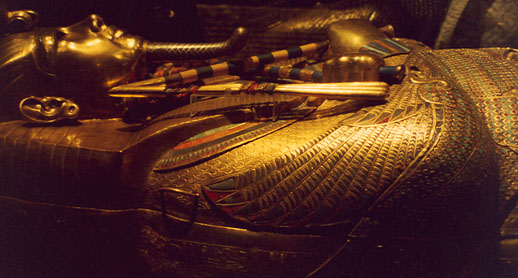
The opulence of the spoils of Tutankhamen's tomb, discovered by Howard Carter in 1922, holds great power. This young son of the unpopular Akhenaten is considered a minor Pharaoh and was most likely murdered young. His tomb was never actually completed and its contents appeared hastily arranged. Yet it contained unbelievably extravagant amounts of gold, jewelry, adornments and artifacts. The perfectly preserved contents of Tut's tomb literally fill room after room of the museum. The tomb remained undisturbed simply because Tut was deemed so insignificant that Ramses VI was buried directly over top it, obscuring its entrance from grave robbers in the Valley of the Kings.
The jewelry from Tut's tomb was magnificent. They were hundreds upon hundreds of exquisitely designed gold pieces, many inlaid with precious stones, others finely painted. Solid gold boxes as large as small rooms were intricately adorned with beautiful designs and actually were originally nestled within each other like a huge golden puzzle. The magnificent and realistic golden death mask of the young pharaoh seemed the most central piece of the display; the face clearly showed that this Pharaoh died more a boy than a man.
Feeling exhausted, yet not wanting to leave the museum, I once again found myself awed by the very experience of being within Egypt. It felt surreal that I was actually walking among the cavernous halls of the Cairo Museum that simply overflowed with the world's greatest collection of ancient Egyptian art and artifacts. Very dreamlike and otherworldly was the experience, almost as if I were observing myself from a distance, separate yet aware. I look down now and see myself walking those halls. I feel thousands of years of Egyptian history and culture engulf me. Then knowingly, lovingly, I am embraced by exquisite recognition of who I am.

EGYPT, GIZA AWAITS EXPLORATION
|
|