|
|
|
|
|
|
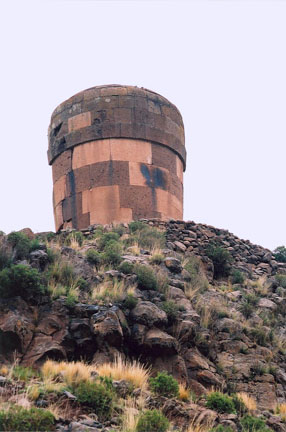 PERU, SILLUSTANI TOMB Visit: Train: Cuzco to Puno Photo Gallery Visit: Lake Titicaca Photo Gallery The island's agriculture was self-sustaining. A brilliant system of food production on the island’s terraced slopes had long ago been devised. Land would be planted and harvested one year, then grazed upon by livestock and naturally fertilized the next, then allowed to be fallow before the cycle began again with planting. The soil retained its fertility with this simple, smart system. Above the terraces, the views on the highest points of the island were breathtaking. Our second day on the lake, the local who navigated our small craft informed us that the water was extremely choppy, and could possibly remain so all day. We proceeded onto the lake for about a half-hour; then could go no further due to the roughness and high waves. We anchored in an inlet, and waited it out. Our Captain was smart, as many boats proceeded further, but were forced to come around and join us on the more quiet waters. I found the opportunity to have a deep rest for the hour or two that we bobbed around. The waters never quieted, so we devised a new plan for the rest of the day.
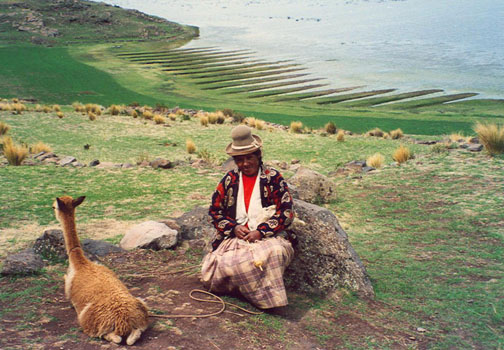
A local woman posed near Lake Umayo with her vicuña, a small and purported nasty relative of the llama and alpaca. Higher and colder climates evolved smaller and smaller versions of these animals. The vicuña is valued for its dense wool, and clothing from it can be quite expensive. The taut rope around its neck kept it well mannered, and it never appeared to consider spitting. Looks did not describe the animal's temperament, however, because it was extremely cute. I found a piece of pottery
near one of the towers, and I was told by our guide that it was quite ancient;
probably from the Tiwanaku culture. We were soon to leave Peru to
visit Lake Titicaca's Bolivian shores, and another important sacred site
for us to experience in Bolivia was Tiwanaku. Daniel had been strongly
drawn to Tiwanaku's Sun Gate from the first time he saw images of it and
read of its history. I left the pottery exactly where I found it
in Sillustani, and blessed the many souls whose bodies had been laid to
rest there. It had been an honor to walk amongst their towering tombs.
I thanked the waves on the lake whose presence that day had created the
space and time for us to visit this ancient and profound burial site.
We left Peru feeling very full and complete. Bolivia called us strongly…
|
|||||||
| TO THE TOP :: THE SITES :: PREVIOUS COUNTRY :: NEXT COUNTRY | |||||||
|
Copyright © 2005 Journey In Spirit and Dolphin Lotus Designs. All photos copyright © Adele Sands. All rights reserved. |